Showing posts with label fiscal policy. Show all posts

Sunday, February 17, 2013

Do Facts Speak for Themselves?

Last week Matthew Yglesias posted a graph at Slate without comment.  It was a FRED graph of "Federal government total expenditures" (Graph 1) and it is a graph that almost has a 90 degree angle.  He said that it speaks for itself.  This reminded me of a lesson that my Professor, Dr. Thomas Rustici, was teaching earlier that week: Facts always speak for themselves, but their meaning is always contextual.

Graph 1


I think this is actually a somewhat misleading graph, which would make this a fact that doesn't speak very well for itself because it is measured in nominal dollars.  If you turn Graph 1 into real dollars (using the consumer price index) you get Federal Government Spending in real dollars.

Graph 2


Graph 2 looks similar to Graph 1, but it is not close to a 90 degree angle.  In some ways, it is more frightening because the recent past looks more like an exponentially increasing function.

Graph 3


The spike in Graph 3 is not the stimulus year of 2009, but rather 2008.  2008 featured a robust Federal budget and several emergency stimulus measures designed to stem the recession.  There was a major tax rebate, but also major spending initiatives including ~300 billion to sure-up Fannie Mae and Freddie Mac, ~700 billion to sure-up the U.S. financial system.  The kink in the downward slope after that spike is 2009 which included the Obama Stimulus.

I bring up Presidents because these graphs are inherently political.  Congress appropriates funds for the Federal Government and the President signs or does not sign those appropriations.  All of these expenditures are painstakingly political.  Here is another graph breaking these expenditures down by Presidential term, averaging the year-to-year difference for their number of years in office.

Graph 4


This has now become a different shape than what we started looking at.  It is essentially still the same information (they are all increasing government spending), but organized in a different way and now it shows something different.  I'll let you draw conclusions from these graphs.  Does it mean that Republicans are bigger spenders than Democrats?  Does it mean that a divided Washington spends less?  Does it depend on which party controls which branch?  These graphs certainly invite these sorts of questions.  Facts always speak for themselves, but they don't say more than the fact.  It is our job to use theory, reason, logic, and fact to make arguments.  That is what Mr. Yglesias, and every economist, makes his living doing and what students such as myself practice and aspire to do effectively.

Graph Four


Graph four is another set of facts.  Please feel free to tell me what it means.

Friday, December 9, 2011

The Avoidable Catastrophe

European Union leaders concluded their latest summit, with their usual small solutions to enormous problems.  Here is a link to their release, detailing their new agreement.  They have decided to offer up more funds for member state bond market stabilization and redoubling their efforts at austerity, which has only exacerbated this problem thus far (including a ridiculous tax on countries that go over the 3% rule).  They still have Italy contributing 17% and Spain 11% of the EFSF funds, which sounds ridiculous given the fact that they are currently mired in severe deficits and Italy is already paying high interest rates to service its debt.  The only good thing to come out of this summit was that nobody has left the Euro (yet).

During the summit, fears and rumors led to multinational corporations reportedly moving their money from countries rumoured to be exiting the Euro to presumed safe countries.  That also probably compounded the bank runs problem in Greece.

Despite markets being up Friday, these problems will likely continue as none of the them have really been solved.  This means that none of the uncertainties that have created deflationary conditions in southern Europe will go away, and the economic conditions will continue to deteriorate.

European leaders signing the Treaty of Rome in 1957

Speculation of this variety does not help, but for countries that could be forced out or leave the Euro, this could amount to an economic catastrophe.  Their country will likely be almost immediately bankrupt unless Eurozone countries agree to continue bailout loans, or a bailout fund through the IMF.  It is hard to imagine that their currency will have any reputation as a store of value.  Their central banks will have little in the way of credibility to create monetary policy.  This will leave these countries in something like a liquidity trap because any monetary policy they try to employ will have little effect.  Deflation will be immediate and substantial, and it will be difficult to turn that around towards inflation or GDP growth.

A liquidity trap is defined as the point that monetary policy is no longer effective because bonds and money are perfect substitutes.  This situation is slightly different, because there will likely be so little demand for bonds, coupled with little central bank credibility that they will not be able to hold down interest rates to stimulate the economy in a meaningful way.  This means that monetary policy will be an ineffective tool to stimulate the economy.  Similarly, these countries will likely not have full sales of their bond offerings, and will have to cut government expenses even more significantly.  GDP will almost assuredly nosedive.  This should be classified as something worse than a liquidity trap because it will be a situation where neither monetary nor fiscal stimulus will be possible.

IS-LM in a Liquidity Trap (Krugman)

What would be left of the Eurozone will not be spared from a significant contraction.  Mark Cliffe of ING speculates that the new currencies would plunge.  His white paper speculates on a full break up of the Euro, but similar movements would be felt from select countries exits.  Similarly, northern European countries will inevitably feel the effects of the severe economic contractions of southern European countries in the form of contractions of their own.  These contractions could last a year in the case of northern Europe and years of severe contraction for southern economies.


The only possible heroes are the European leaders, but it looks as though they are still not truly believing in their own shared destiny.  The main villain can easily be viewed as the European Central Bank (ECB).  Their strong currency position has strained the growth of southern European countries, and even this Spring, they raised rates because of inflation fears.  Thursday, they cut rates, but at a paltry .25%; when Greece, Spain and Italy were literally having capital streaming out of their banks, economy, and even geography.  Much of this agreement seems to be stressing an increased ECB role, but hard to imagine them doing what is necessary to help southern economic conditions.  They will be acting as the operating agent of the EFSF and ESM funds to purchase sovereign debt.  Hopefully they will be more active in that pursuit, than they have in monetary policies.


Solution:

I would argue that there is still time and opportunity to avoid this recession.  I think the best solution is to pool credit risk.  An agency such as the European Stability Mechanism or the European Financial Stabilization Mechanism or another more robust agency could purchase all the debt of all member nations, and in turn issue Euro bonds.  The Eurozone, in total, has a debt to GDP ratio of 85%, which is below the United States and within an acceptable range.  The Euro as a currency has and would continue to have significant transaction demand, and the ECB would continue to have legitimacy and credibility for creating monetary policy.

Creating a true fiscal union (as opposed to the current proposal which merely acts as an enforcement agency of the 3% rule) would also be important to insure that this does not become a repeated problem, and (of course) to pay down the Eurobonds, and pool more government expenses.  These two solutions (Eurobonds and fiscal union) might cause Eurozone nations to rethink whether they actually want to remain in the currency.  It is hard to imagine EU members that have not adopted the Euro join this arrangement which would leave countries like the U.K. and Sweden out.  For that reason, I think secondary treaties such as a greater European community (but explicitly non-EU) would be important for keeping important commercial and economic ties, while being excluded from a federal system and unified currency and bonds.


It does not look like enough European leaders are interested in this arrangement.  I think we are still staring at a difficult situation in Europe that hasn't really been solved.  If conditions continue to deteriorate, European leaders will be forced to hold another summit, and who knows how much longer bond markets are going to tolerate these half-steps.  They're barely tolerating it now!

If countries leave the Euro, France and Germany will instead likely be somewhat forced to bail out banks that will be overexposed to southern European debt or too weak to withstand this recession (Commerzbank, which is trading at an awfully low price of € 1.37 might be the first) or face a more severe recession of their own.  Southern Europe will be have negative economic growth for years.  It should be considered a failure of leadership that Europe was not able to find a way towards this solution over the past year and a half.

Friday, October 14, 2011

Debt and Economic Cycles

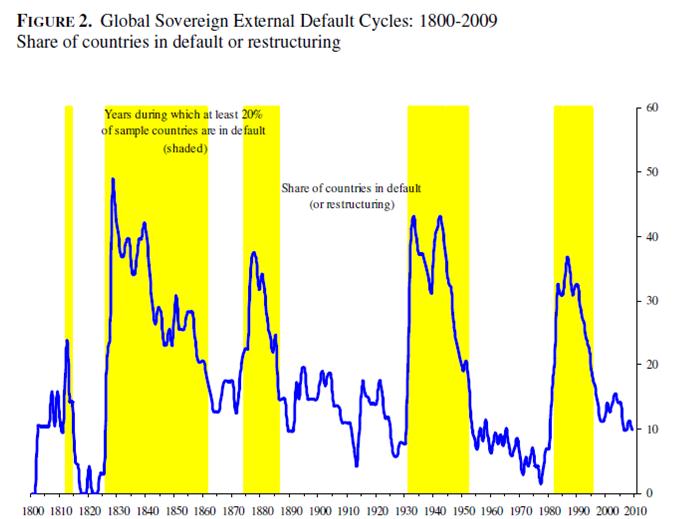
Carmen Reinhart and Kenneth Rogoff have written an especially relevant article in the latest issue of The American Economic Review titled "From Financial Crash to Debt Crisis."  Many of the concepts are in their latest book, This Time is Different: Eight Centuries of Financial Folly.  They create a new and more detailed data series concerning public debts in many countries, developing and developed over a two century period.

The article has four main points:
1) Debt to foreign creditors usually happens before a banking crisis
2) Bank crises precede or are simultaneous with sovereign debt crises
3) Public borrowing surges right before sovereign debt crises
4) Public and private borrowing frenzy with bursts of hyperinflation


They meticulously document this through long data series of public debt, which show cycles.  These cycles are longer than a generation; they foster a "This time is different" approach to handling the situation (usually with more debt).  The policy makers believe that they are smarter and have better systems of handling financial issues than previous episodes.  The history shows that they are wrong about this.

These issues remind me of the old ideas of Nikolai Kondratieff.  He first observed large historical waves within the economy that tended to last 40 to 60 years.  He noticed several stages within the waves.

Nikolai Kondratieff

The first stage is economic expansion.  These expansions often involved new technology, minor wars and social upheaval.  The net effect is a large amount of new investment.  The second stage is the peak.  General affluence causes shortages and production becomes strained to keep up.  This stage is also marked by a different type of war, that of absolute wars.  The first adjustment typically happens at the end of the absolute war.  The public debt grows so large that the economy must adjust for more balanced budgets.

The stage that he describes as the plateau is actually the initial phase of the decline.  It is actually a slight decline, that is marked by an increase in speculation.  The next phase is the panic.  This is marked by bank failures and sharp declines in public confidence.  The next stage is the decline, and it is marked by a lack of confidence and doubt.

(source: http://www.longwavegroup.com/)

Kondratieff was never able to fully explain why these happened with such regularity other than with data.  Another issue was that he was not able to explain their variation in amount of years.  Because of this, and the fact that he was murdered in one of Joseph Stalin's purges, his ideas have not been well accepted in the world of economics.  These ideas were popularized in the western world by Joseph Schumpeter, in his book, Business Cycles, "incessantly destroying the old one, incessantly creating a new one.  The process of Creative Destruction is the essential fact about capitalism."

One of the standing observations in long wave literature is that wars are an essential element to them.  I would submit that wars could be turned into a more general government expense and more importantly debt.  Far and away, the most common way that government's went into debt was through war until the last century.  Now, there are several main ways that governments have acquired large debts in the past wave.  War has certainly still been a feature, but social welfare has become an increasingly public function in the past 100 years.  Wealth transfers and subsidized loans from developed to developing countries has continued even after colonialism has largely subsided.  Bureaucracy, in some countries such as the United States, has become larger in the past 100 years.  The culmination of these factors has created increases in government expenditure.  So while we may have escaped a peak without an all out war, we have more than made up for it with other government expenditures and most critically, debt.

Now, as we are in a panic, and we are potentially observing defaults and bankruptcies.  Confidence is certainly becoming lower and lower, I think these ideas are worth revisiting.  The reason that I tie Reinhardt and Rogoff's works to Kondratieff and Schumpeter is that I think Reinhardt and Rogoff may actually be observing critical factors of peaks, panics, and the decline... while ignoring the larger picture.  Rogoff, in recent interviews, has spoken about public debt overhangs crippling economies for long periods of time.  These debt overhangs probably are the result of government expansion, which led to periods of increased monetary base, only to be met with malinvestment and over expansion.  Keynesian economics would teach us to fight these panics and decline with further debt to return us to the production possibility frontier, but that only ends up adding to the debt overhang.

Kenneth Rogoff (Photo: World Economic Forum)

Of course, I have proved nothing and this will need much more study.  I think these issues relate to the heart of our current financial crisis in Europe and by contagion the rest of the world.  The question 'should we bail out our banks' is never a pleasant one, but the amount of debt that the nation takes on likely has much to do with the length of its decline.  Kondratieff explained the decline as a period that lacked confidence, but it lacked confidence because of fearful business conditions.  Perhaps Rogoff's "debt overhang" plays a part in that.


Works Consulted:

Goldstein, Joshua.  Long Cycles.  New Haven: Yale University Press.  1988.  Print.
Mager, Nathan.  The Kondratieff Waves.  New York: Praeger.  1987.  Print.
Reinhardt, Carmen and Kenneth Rogoff.  "From Financial Crash to Debt Crisis."  The America Economic Review.
     Pittsburgh: American Economic Association.  August 2011.  Journal.
Schumpeter, Joseph.  Business Cycles.  New York: McGraw-Hill.  1939.  Print.


Radiohead - "Codex"

Monday, September 19, 2011

Is Europe Equipped for this Financial Crisis?

European finance ministers met last weekend in Wrocław, Poland without reaching an agreement on Greek debt.  Decisions like this are difficult for any political process, but the scale of this problem and the nature of Europe's political power structure leaves me wondering if Europe will even be able to come to an agreement on any bail outs, bankruptcy, or similar issues.  There is not a strong federal infrastructure, which means that any agreements are constructed somewhat ad hoc and dependent upon near consensus to reach a feasible agreement.  So it seems that there are many ways that these intense negotiations could derail, and a difficult road to a potential agreements.

Wrocław, Poland (photo: Stefan Schlautmann)

There are many ideas being floated to solve these issues.  One includes a larger role for the European Union (E.U.), others include Euro bonds.  Philipp Rösler, Vice Chancellor of Germany, is calling for new procedures that would allow Greece or other nation states in the European Union to declare bankruptcy.  He has also announced his opposition to Euro bonds.  In an op-ed for Die Welt, Rösler continues to oppose increased central powers in Brussels, instead preferring a code for member state budgets and sanctions against straying countries.

Philipp Rösler (photo: Liberale)

Rösler plays a new, but pivotal role in the European sovereign debt crisis.  He has recently assumed the Chair of the Free Democrat Party (FDP) in Germany.  This is the party that helps Chancellor Angela Merkel's Christian Democratic Union (CDU) party form a majority in the Bundestag.  Rösler has only been chair since May when Guido Westerwelle stepped down following terrible regional election results.  The party declined further in last Sunday's elections in Berlin.  The FDP has declined after not delivering on promises to lower taxes.

82% of Germans are unhappy with the way that the German coalition government has handled the European sovereign debt crisis.  With disapproval levels so high, German political instability could be an additional hurdle to any European debt negotiations.  Germany has a parliamentary system, so while the next scheduled election isn't until the Fall of 2013, another election could happen earlier if Merkel cannot survive a no-confidence vote.  In that case, a snap election would be 60 days after the dissolution of the Bundestag.  Rösler stated this week that his party remains committed to that coalition.


Merkel's Union party is still atop the polls as of this month with 31% support, but Social Democrat party gains are threatening to overtake them with 29%.  Because there are five semi-viable parties in Germany, coalition governments are the norm.  The question is: how long can the FDP continue to stay in a coalition while their numbers are plummeting?  Will they need to make a change in political stance in order to maintain their viability?


COMPLEX INTERNAL POLITICS

This shows some of the complexity problems that Europe is dealing with.  Every member state has their own political processes that their politicians are trying to gauge and win.  These domestic politics may be at odds with larger continental politics.  For instance, at the negotiations in Poland, Finland was demanding collateral for their loans, which likely contributed to the non-agreement.  It is doubtful that one party kept that group from agreeing to more loans, but it shows how difficult it will be to satisfy everyone.  In cases such as these, how can markets truly judge which way governments will act?  These uncertainties are adding to market pressures.  With Greek default looking increasingly likely and even imminent, markets are wondering what a Greek default would look like, and how it will impact the Euro.

This lack of certainty is fueling frustration.  83% of Germans recently said that they were dissatisfied with the amount of information that they received regarding current European events.  These events have been difficult for me to judge, but I always assumed that was because I was on this side of the Atlantic.  I can't tell if I should be happy, relieved, or more worried that continental Europeans are just as frustrated as I am at the lack of information coming out of Athens and the other capitols of Europe.

Tomorrow, Greece has interest payments on two bonds worth over 768 million euros bonds to pay.  They have said that they have enough cash to pay them, but there was also a recent story that less than 75% of banks are going to repurchase Greek debt when it comes due again.  If fewer institutions are willing to buy Greek debt at any interest rate, there is little that anyone can do to stop a default.  If Greece does default, I don't know if anyone knows exactly what that will mean.  Will they stay in or out of the E.U.?  Will they stay in or out of the Euro?  Are those mutually exclusive?  If they stay in, how are other countries affected by Greek commitments?  If they stay in, how much sovereignty do they retain?  Do they become a second tier nation within the E.U.  Also, if Greece does default, wouldn't they actually need to devalue whatever currency they have anyways to regain their competitiveness?  There really are so, so, so many questions.

This situation is likely to continue deteriorating, with any Greek default only adding to problems in Italy and other economies.  Even if there were a strong popular consensus, I think it will be difficult for the European Union to arrive at large decisions like this in crisis situations.  Given their current fractured opinions, compromises seem even more difficult, and as such, a catastrophic financial crisis seems more likely.


Leonard Cohen - "Everybody Knows"

Monday, September 12, 2011

The German Dilemma

Simon Maughan of MF Global summed up the current European financial situation very well when he was interviewed last Wednesday on Bloomberg Surveillance.  He posed the question:


Spoken like a true banker, but that is Germany's current dilemma.  Maughan also spoke about Basel III and other European financial issues.

Simon Maughan on Bloomberg Surveillance (MP3) via Bloomberg


Thursday, August 4, 2011

Did We Kill the Golden Goose?

The American Armageddon was averted earlier this week when Congress and the President reached a deal to raise the debt ceiling and avoid defaulting on its obligations.  Since the deal was reached, many on both sides are fuming about various aspects of the deal.  Presidential candidates are already using it to position themselves to constituency and the world is still turning.  One of the questions that is being brought up in the wake of falling stock markets and general media inquiry, did we kill the golden goose?  Will we lose our AAA bond status?  Are bond purchasers going to be less attracted to our securities?


Chart 1 - Dow Jones Industrial Average (7/29/11-8/4/11)


Chart 1 shows the Wall Street sell off this week.  Is this sell-off because of insecurity about the U.S. government paying its bills based on resistance to raise the debt ceiling?


Chart 2 - Dow Jones Industrial Average (8/3/09-8/3/11)


You can see the market has been climbing quite a bit in the past year.  I suppose our outlook has grown rosier in the past two years, but perhaps it is getting more pessimistic with job numbers at almost negative growth and GDP about the same.  Market bull runs tend to take on a momentum of their own and continue past the point that economic indicators begin hinting at weakness, so perhaps the market is finally succumbing to neutral economic indicators and is beginning to feel alarmed.


Chart 3 - One Month Treasury Note Rates (8/3/09-8/3/11)


Please note the scale on Chart 3, the reason that it looks as variable as it does is only because of how little variability there actually has been in it.  If one view this graph from before the recession began, it looks quite different.


Chart 4 - One Month Treasury Note Rates (8/3/02-8/3/11)


This graph gives a bit more history to the debate.  What I notice is how closely it follows the Federal Funds rate that the Federal Open Market Committee sets.  This makes sense because the main way that the Fed does this is through Treasury Note repurchase agreements with Treasury Department primary dealers.


Chart 5 - Federal Funds Effective Rate (8/3/02-8/3/11)


The grey portion in Chart 5 shows a period of recession.  The Federal Reserve's Federal Open Market Committee meets once every seven weeks (roughly) to decide whether to raise or lower interest rates.  They then set a target rate, and it is up to the traders at the Fed Board and regional Reserve Banks to meet that target.  It's easy to be oblivious to the ways in which the government intervenes in our markets.  But these last two graphs show pretty well why the U.S. Treasury bond market wouldn't and perhaps couldn't react to any insecurity over a potential U.S. default.


Chart 6 - 100 Oz Gold in Dollars (5/3/11-8/3/11)


This chart shows the price of 100 ounces of gold over the past three months.  I use this chart to show the decline of the Dollar.  One could argue that there is a significant speculative market in gold, but I would counter that this speculation is actually a short on the major world currencies.  Surely these speculators are not guessing that the demand for gold jewelry has risen 10% over the past month!

Ordinarily, when someone is trying to show weakness in the Dollar, they would compare it to another world currency such as the British Pound, Japanese Yen, or more recently the Euro.  This would be fine, but the Dollar has been somewhat on par compared to these currencies because most developed economies are in lackluster shape and sovereign debt levels are high for most of these countries.


So have we killed the golden goose?

Many are speculating the Republicans have killed the golden goose by showing that Congress may not have the political will to pay back its debtors.  I think this is attacking the wrong problem.  Even if we had not had this debacle with the debt ceiling, I think it is likely that we would be facing credit rating downgrades.  The reason we will face those downgrades is because our debt to income to ratio has been  quickly rising.  Our prospects of lowering it, or even significantly slowing this rising ratio only came about because of Republican hold-outs last week.  The truth is the the U.S. debt rating has already been lowered by one agency that I know of (大公国际资信评估有限公司, in China).  It is the largest credit rating agency in China (I don't know if that means anything) but I don't know if that has truly affected rates.  Then again I'm not sure that even a Moody's downgrade will affect us after looking at that Federal Funds Rate (Chart 5) compared to Treasury One Month Rates (Chart 4).  It appears that the Fed is willing to do whatever it takes to hold down Treasuries.

All this sort of exposes the United States as becoming a banana republic.  The government spends our money, and then taxes us through the backdoor via inflation.  I've long wondered that with the United States having such a large debt for so long, what it would take to go bankrupt.  It seems to have a bottomless pit to borrow and repay yesterdays loans (read: ponzi scheme).  It seems then that the true way that the U.S. Federal government would ever go bankrupt is by holding a Treasury bond auction that nobody came to.  So perhaps we have killed the golden goose, but not in a way that is at all obvious, yet.


Thursday, July 21, 2011

The Debt Ceiling

The world of politics keeps on spinning and as a student of economics I try to learn as much as I can and to a large extent keep my mouth shut because I, by definition, don't know everything yet.  The situation is that the U.S. government has already reached the limit for the amount of money that it can borrow and has been using some internal creative accounting to finance expenditures over that amount.  On August 2nd, they will have exhausted those means for acquiring money and will not have enough money to pay their bills which include the U.S. Treasury bonds that come due.  If they do not pay those Treasury bonds in a timely fashion, we will have defaulted on our debt and there will likely be substantial fall-out.


Most or all Democrats say that we should raise the debt limit immediately.  Republicans have more mixed feelings about it.  Some are opposed to raising the limit no matter what.  Others want to extract substantial spending cuts and some would even like to vote on a balanced budget amendment to the Constitution.  Financial experts are warning that a U.S. default would have dire consequences for the domestic and international economy, so why is Congress cutting it so close?

In part, it is because they disagree about fundamental aspects of the debate including whether we will actually default.  Many Republicans assert that on August 2nd, when money runs short, the Treasury department can pick and choose which programs to fund and which not.  It is assumed, in this first scenario, that no matter which programs get chosen for no payments or delayed payments, the bonds will be paid.  This is an enormous assumption because it would be completely unprecedented.  The second scenario is the President can simply ignore the debt limit citing the 14th amendment to the constitution:

Section 4. The validity of the public debt of the United States, authorized by law, including debts incurred for payment of pensions and bounties for services in suppressing insurrection or rebellion, shall not be questioned. But neither the United States nor any State shall assume or pay any debt or obligation incurred in aid of insurrection or rebellion against the United States, or any claim for the loss or emancipation of any slave; but all such debts, obligations and claims shall be held illegal and void.
I think both of these scenarios would be challenged in the courts on Constitutional grounds.  Obviously if the President ignores the Debt Ceiling law, he will be sued (by Congress? or members of Congress?) and it will probably get an express train to the Supreme Court.  I have no idea what they will say about this, but it doesn't seem like a great scenario if we haven't struck a deal by the time the Supreme Court has to give an ultimate ruling.  Former President Clinton has said that he would pursue this course of action if he were in office.

The first scenario is also fraught with risk.  For one thing, government expenditures and income are very uneven.  We risk not having working capital for the day to day operations of critical elements of our government (military, courts, and debt.).  The reason that August 2nd is the day is because we have an enormous amount of checks to pay out on August 3rd (mostly for Social Security).  Will this mean that Social Security must be cut for this option?  Many Republicans are bringing up the various sillier parts of the federal budget like research grants for this and that, foreign aide, the national parks, etc.  They insinuate that we can simply choose to cut those out.  What if those aren't the checks that are due that day?  What if it's checks for V.A. hospitals, or soldier's pay checks, or the electric bill at the U.S. Congress building.  What if any of those are the ones that push us over the limit?  It seems likely that the Social Security checks on August 3rd will be the ones that we will not have the means to pay.  If that is the case, are Republicans really comfortable cutting Social Security with no warning?  That would mean a lot of people on fixed incomes would not get a check, and there would be consequences to that.

Many people say that we should cut spending, including Social Security, and that this is a way to do that.  That may be true, but this would be perhaps the worst way to cut Social Security... even if it were simply a temporary cut.  Most Americans that receive Social Security completely depend on it for their means of survival.  Major changes to this program would require a lot of advance notice and would cause major changes in our entire economy.  For many Americans, it would be completely impossible for them to resume working, and it is morally unfair not to give them retirement benefits which they have been paying into their entire working lives for.

That's not even the worst case for the first scenario.  The worst case is that the Treasury department decides that it does not have the Constitutional authority to make spending decisions and simply continues to pay the bills as they come in until they have no more money.  Then, as soon as a U.S. bond comes in without any working capital in the U.S. account, we will officially default for the first time.

I agree with other financial experts that a U.S. default would likely be the worst bankruptcy of all time.  It would make the Lehman Brothers collapse look like a minor event.  I don't care to go to much into the speculation, because it's impossible to truly speculate on what that event would be like, so I'll simply call it a "game changer" for the global economy.

For my entire life, I've wondered why the U.S. government spends so much money.  I've always been for cutting government expenditures and have never really understood why we even ran a deficit on such a regular basis.  I support passing some version of a balanced budget amendment even if it's watered down and has opt outs in times of war.  Still, I think Republicans might be risking a default just to make a point about the deficit and debt, which is nonsense.

It seems that the general public, which has handed elections over to Republicans since President Obama's historic win has also grown doubtful over Republican handling of this impasse.  So, please, Democrats, Republicans... MAKE A DEAL!