Showing posts with label sovereign debt. Show all posts

Tuesday, January 17, 2012

Too Late for Greece?

S&P downgraded a number of the Euro-zone nations last Friday, including France, Austria, Italy, Spain, Portugal, and others.  They did this writing, "The outcomes from the E.U. summit on Dec. 9, 2011, and subsequent statements from policymakers, lead us to believe that the agreement reached has not produced a breakthrough of sufficient size and scope to fully address the Euro-zone's financial problems."  They go on to assess the recent European Central Bank monetary policy actions as "instrumental in averting a collapse of market confidence."

Athens (photo: Steve Swayne)

Additionally, S&P's managing director Moritz Kraemer told Bloomberg, "Greece will default very shortly. Whether there will be a solution at the end of the current rocky negotiations I cannot say."  Adding, "There is a lot of brinkmanship on and a disorderly default will have ramifications on other countries but I believe policymakers will want to avoid that ... The game is still on."

Kraemer is calling the Greek default based on European Union (E.U.) plans to force current Greek debt holders to "roll over" Greek debt into new debt instruments such as EFSF bonds (which was also downgraded from AAA to AA+).  "Even the debt exchange, by our definition, is a default.  It's a distressed exchange."  The ratings agency, Fitch has also indicated that it believes that would be a default as well.  The Wall Street Journal is setting a date on the potential default as March 20, 2012.  Apparently Greece has an especially large amount of debt to repay that day, and they do not currently have the money, so they will either need another large bail out or a rollover program in place.

There seems to be an enormous decoupling of Greek debt from the primary market, which has had small interest rate increases and the secondary market, which has seen interest rates rise quickly.  The secondary market is seeing Greek government one year bond spike to as high as 415%.  Greece has stopped offering one year debt, but their 26 week debt interest rates went for significantly less, 4.9% at their last auction last Tuesday.  This decoupling suggests the large extent to which the E.U. is bailing out Greece, and that few other institutions are joining them in loaning to Greece.

(chart via Bloomberg)

The run up in the secondary market also happened after this rollover plan was announced.  Details of this plan have not been finalized, and this is what S&P and Fitch are saying will constitute a default when it occurs.  The ECB is saying that it will still accept Greek debt as collateral if even only one of the three major ratings agencies does not declare Greece in default.

This comes on the heels of success for the E.C.B.'s fine tuning program, which drove down yields last week on Greek debt (slightly), and Italian debt.  I have to worry if this program, as fine suited as it is for putting out the flames of this crisis, is too little too late for Greece (and then perhaps for the rest of Greece if contagion overwhelms).  If contagion and crisis does spread from either a Greek default or a Greek exit from the Euro... one has to place a large amount of blame on the ECB (under Jean-Claude Trichet) for not starting their fine tuning earlier, and attempting to target it towards Greece which has seen a significant shrinking of their M2 all year.

Greece is auctioning off more 13 week debt today.

Tuesday, January 10, 2012

2012 Italian Debt Watch Begins

Italy's Dipartimento del Tesoro will be making the first debt offering of 2012 on Thursday, January 12, 2012.  They will offer 3 month and 12 month securities to replace ones that become mature on January 16th.  This will be another test of the European Central Bank's latest 'fine tuning,' which I wrote about last month.  Hopefully their lending will allow banks to strengthen themselves through arbitrage and hold down Italian, Greek, and other yields so that their governments can function.


Here is a link to their 2012 auction calendar.  The general public cannot participate in the auctions, but it might give you a better idea about some key dates for Italy's financial future.

Wednesday, November 9, 2011

We're Gonna Need A Bigger Boat


via Bloomberg
It is starting to really hit the fan in Italy as yields on 10 year Italian bonds hit 7.4%!  This was always the country that everyone was worried about when they were talking about the other PIGS (Portugal, Italy, Greece, Spain), and it looks as though Italy is almost tipping over.  This recent market action has been the main cause for the President of the Council of Ministers, Silvio Berlusconi, to resign.  This news has not stopped the market from driving up the yield for Italian bonds further.

Palazzo Montecitorio, Rome (photo: Marco Assini)

It remains to be seen what, if anything, the Eurozone can do to help the Italian bond market, as they have with Greece.  Economists and market watchers have long said that Italy is too big to get the same "fixes" that Greece received.  The wheels keep churning at the Italian Ministry of Economy and Finance, they'll be having new bills issued tomorrow, and more 10 year bonds next week.  This might be the one of the more interesting months in economic history, as it might see one or more countries exiting the Euro.  It seems the economics blogosphere is abuzz with that idea, and rumors are spreading that top French and German officials are already discussing how it would happen.

Most currency changes are done years in advance so that all market participants understand what is happening.  The Euro was introduced over a three year period, initially (1999) only electronically, and older currencies were still accepted physically until 2002.  It is likely that if the Euro shrinks in terms of countries, or if it is scrapped altogether, it will happen quickly.  If Greece reintroduces the Drachma, or Italy the Lira, it will be almost overnight.  This will be an awful shock to the economy.  Deflationary pressures will be enormous, and productivity losses could be severe due to loss in the medium of exchange because large economic areas won't have currencies for a period.  It will be ugly, but the uncertainty of how ugly is enormous.


Friday, October 14, 2011

Debt and Economic Cycles

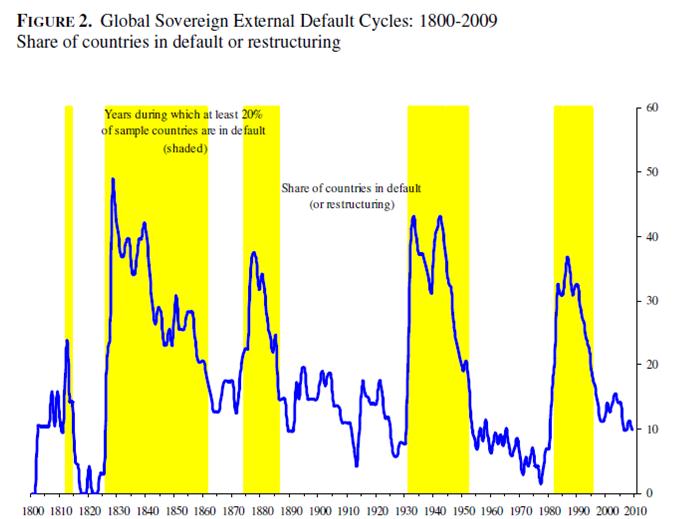
Carmen Reinhart and Kenneth Rogoff have written an especially relevant article in the latest issue of The American Economic Review titled "From Financial Crash to Debt Crisis."  Many of the concepts are in their latest book, This Time is Different: Eight Centuries of Financial Folly.  They create a new and more detailed data series concerning public debts in many countries, developing and developed over a two century period.

The article has four main points:
1) Debt to foreign creditors usually happens before a banking crisis
2) Bank crises precede or are simultaneous with sovereign debt crises
3) Public borrowing surges right before sovereign debt crises
4) Public and private borrowing frenzy with bursts of hyperinflation


They meticulously document this through long data series of public debt, which show cycles.  These cycles are longer than a generation; they foster a "This time is different" approach to handling the situation (usually with more debt).  The policy makers believe that they are smarter and have better systems of handling financial issues than previous episodes.  The history shows that they are wrong about this.

These issues remind me of the old ideas of Nikolai Kondratieff.  He first observed large historical waves within the economy that tended to last 40 to 60 years.  He noticed several stages within the waves.

Nikolai Kondratieff

The first stage is economic expansion.  These expansions often involved new technology, minor wars and social upheaval.  The net effect is a large amount of new investment.  The second stage is the peak.  General affluence causes shortages and production becomes strained to keep up.  This stage is also marked by a different type of war, that of absolute wars.  The first adjustment typically happens at the end of the absolute war.  The public debt grows so large that the economy must adjust for more balanced budgets.

The stage that he describes as the plateau is actually the initial phase of the decline.  It is actually a slight decline, that is marked by an increase in speculation.  The next phase is the panic.  This is marked by bank failures and sharp declines in public confidence.  The next stage is the decline, and it is marked by a lack of confidence and doubt.

(source: http://www.longwavegroup.com/)

Kondratieff was never able to fully explain why these happened with such regularity other than with data.  Another issue was that he was not able to explain their variation in amount of years.  Because of this, and the fact that he was murdered in one of Joseph Stalin's purges, his ideas have not been well accepted in the world of economics.  These ideas were popularized in the western world by Joseph Schumpeter, in his book, Business Cycles, "incessantly destroying the old one, incessantly creating a new one.  The process of Creative Destruction is the essential fact about capitalism."

One of the standing observations in long wave literature is that wars are an essential element to them.  I would submit that wars could be turned into a more general government expense and more importantly debt.  Far and away, the most common way that government's went into debt was through war until the last century.  Now, there are several main ways that governments have acquired large debts in the past wave.  War has certainly still been a feature, but social welfare has become an increasingly public function in the past 100 years.  Wealth transfers and subsidized loans from developed to developing countries has continued even after colonialism has largely subsided.  Bureaucracy, in some countries such as the United States, has become larger in the past 100 years.  The culmination of these factors has created increases in government expenditure.  So while we may have escaped a peak without an all out war, we have more than made up for it with other government expenditures and most critically, debt.

Now, as we are in a panic, and we are potentially observing defaults and bankruptcies.  Confidence is certainly becoming lower and lower, I think these ideas are worth revisiting.  The reason that I tie Reinhardt and Rogoff's works to Kondratieff and Schumpeter is that I think Reinhardt and Rogoff may actually be observing critical factors of peaks, panics, and the decline... while ignoring the larger picture.  Rogoff, in recent interviews, has spoken about public debt overhangs crippling economies for long periods of time.  These debt overhangs probably are the result of government expansion, which led to periods of increased monetary base, only to be met with malinvestment and over expansion.  Keynesian economics would teach us to fight these panics and decline with further debt to return us to the production possibility frontier, but that only ends up adding to the debt overhang.

Kenneth Rogoff (Photo: World Economic Forum)

Of course, I have proved nothing and this will need much more study.  I think these issues relate to the heart of our current financial crisis in Europe and by contagion the rest of the world.  The question 'should we bail out our banks' is never a pleasant one, but the amount of debt that the nation takes on likely has much to do with the length of its decline.  Kondratieff explained the decline as a period that lacked confidence, but it lacked confidence because of fearful business conditions.  Perhaps Rogoff's "debt overhang" plays a part in that.


Works Consulted:

Goldstein, Joshua.  Long Cycles.  New Haven: Yale University Press.  1988.  Print.
Mager, Nathan.  The Kondratieff Waves.  New York: Praeger.  1987.  Print.
Reinhardt, Carmen and Kenneth Rogoff.  "From Financial Crash to Debt Crisis."  The America Economic Review.
     Pittsburgh: American Economic Association.  August 2011.  Journal.
Schumpeter, Joseph.  Business Cycles.  New York: McGraw-Hill.  1939.  Print.


Radiohead - "Codex"

Monday, September 19, 2011

Is Europe Equipped for this Financial Crisis?

European finance ministers met last weekend in Wrocław, Poland without reaching an agreement on Greek debt.  Decisions like this are difficult for any political process, but the scale of this problem and the nature of Europe's political power structure leaves me wondering if Europe will even be able to come to an agreement on any bail outs, bankruptcy, or similar issues.  There is not a strong federal infrastructure, which means that any agreements are constructed somewhat ad hoc and dependent upon near consensus to reach a feasible agreement.  So it seems that there are many ways that these intense negotiations could derail, and a difficult road to a potential agreements.

Wrocław, Poland (photo: Stefan Schlautmann)

There are many ideas being floated to solve these issues.  One includes a larger role for the European Union (E.U.), others include Euro bonds.  Philipp Rösler, Vice Chancellor of Germany, is calling for new procedures that would allow Greece or other nation states in the European Union to declare bankruptcy.  He has also announced his opposition to Euro bonds.  In an op-ed for Die Welt, Rösler continues to oppose increased central powers in Brussels, instead preferring a code for member state budgets and sanctions against straying countries.

Philipp Rösler (photo: Liberale)

Rösler plays a new, but pivotal role in the European sovereign debt crisis.  He has recently assumed the Chair of the Free Democrat Party (FDP) in Germany.  This is the party that helps Chancellor Angela Merkel's Christian Democratic Union (CDU) party form a majority in the Bundestag.  Rösler has only been chair since May when Guido Westerwelle stepped down following terrible regional election results.  The party declined further in last Sunday's elections in Berlin.  The FDP has declined after not delivering on promises to lower taxes.

82% of Germans are unhappy with the way that the German coalition government has handled the European sovereign debt crisis.  With disapproval levels so high, German political instability could be an additional hurdle to any European debt negotiations.  Germany has a parliamentary system, so while the next scheduled election isn't until the Fall of 2013, another election could happen earlier if Merkel cannot survive a no-confidence vote.  In that case, a snap election would be 60 days after the dissolution of the Bundestag.  Rösler stated this week that his party remains committed to that coalition.


Merkel's Union party is still atop the polls as of this month with 31% support, but Social Democrat party gains are threatening to overtake them with 29%.  Because there are five semi-viable parties in Germany, coalition governments are the norm.  The question is: how long can the FDP continue to stay in a coalition while their numbers are plummeting?  Will they need to make a change in political stance in order to maintain their viability?


COMPLEX INTERNAL POLITICS

This shows some of the complexity problems that Europe is dealing with.  Every member state has their own political processes that their politicians are trying to gauge and win.  These domestic politics may be at odds with larger continental politics.  For instance, at the negotiations in Poland, Finland was demanding collateral for their loans, which likely contributed to the non-agreement.  It is doubtful that one party kept that group from agreeing to more loans, but it shows how difficult it will be to satisfy everyone.  In cases such as these, how can markets truly judge which way governments will act?  These uncertainties are adding to market pressures.  With Greek default looking increasingly likely and even imminent, markets are wondering what a Greek default would look like, and how it will impact the Euro.

This lack of certainty is fueling frustration.  83% of Germans recently said that they were dissatisfied with the amount of information that they received regarding current European events.  These events have been difficult for me to judge, but I always assumed that was because I was on this side of the Atlantic.  I can't tell if I should be happy, relieved, or more worried that continental Europeans are just as frustrated as I am at the lack of information coming out of Athens and the other capitols of Europe.

Tomorrow, Greece has interest payments on two bonds worth over 768 million euros bonds to pay.  They have said that they have enough cash to pay them, but there was also a recent story that less than 75% of banks are going to repurchase Greek debt when it comes due again.  If fewer institutions are willing to buy Greek debt at any interest rate, there is little that anyone can do to stop a default.  If Greece does default, I don't know if anyone knows exactly what that will mean.  Will they stay in or out of the E.U.?  Will they stay in or out of the Euro?  Are those mutually exclusive?  If they stay in, how are other countries affected by Greek commitments?  If they stay in, how much sovereignty do they retain?  Do they become a second tier nation within the E.U.  Also, if Greece does default, wouldn't they actually need to devalue whatever currency they have anyways to regain their competitiveness?  There really are so, so, so many questions.

This situation is likely to continue deteriorating, with any Greek default only adding to problems in Italy and other economies.  Even if there were a strong popular consensus, I think it will be difficult for the European Union to arrive at large decisions like this in crisis situations.  Given their current fractured opinions, compromises seem even more difficult, and as such, a catastrophic financial crisis seems more likely.


Leonard Cohen - "Everybody Knows"

Wednesday, September 7, 2011

Sovereign Debt Issues Fueling New Financial Panic?

Not all market crashes happen in the Fall, but it does seem to be a historically popular time for them.  Europe's sovereign debt situation looks awful.  This presents difficult situations for the nations that are involved because it is dramatically more expensive for them to access the credit markets.  Most coverage has focused on austerity measures that governments are taking and the European Central Bank's (ECB) purchasing bonds from these countries, effectively holding rates down lower than they would be naturally.  Because of this, the ECB has been trying to hold government's feet to the fire about austerity, and that has been controversial because of sovereignty issues.

The European Central Bank (photo: Margit Myers)

This situation presents a much worse situation for firms and individuals holding the debt, especially firms holding large amounts of sovereign debt.  Because of this situation, there may be a new financial crisis brewing in Europe.  The New York Times is reporting that European financial stocks have been especially hit hard, and that some of these firms may fall into that "too big to fail" category.  The one that has persistently been dogged with rumors is Société Générale, whose stock price is below half what it was at the beginning of summer.

Despite its moral hazard, bailing out the banks played an enormous role in limiting contagion in the global financial panic of 2007.  The United States, United Kingdom, Ireland, and several other countries literally propped up bankrupt financial institutions to avoid a collapse of the house of cards known as international finance.  The ECB has spent billions bailing out European nations; will it have the ammo or the will to bail out any banks?  If it doesn't, how far will the contagion spread?

Here is a series of charts showing the last five years for several major market indexes.  The first one in Paris shows that the Parisian market is almost down to the lows it had during the recession.

CAC 40 (Paris)


DAX (Frankfurt)


FTSE (London)


DJIA (New York)


Hang Seng (Hong Kong)


One thing that is easy to observe is the similar look of them.  There is an especially sharp decline in the late September and early October 2008.  All of these charts declined:

CAC 40: ~ -22%
DAX: ~ -35%
FTSE: ~ -20%
DJIA: ~ -25%
Hang Seng: ~ -32%

Since July they have all had similar declines:

CAC 40: ~ -25%
DAX: ~ -29%
FTSE: ~ -13%
DJIA: ~ -13%
Hang Seng: ~ -13%

(all figures are very approximated)

If we do have another global recession coming our way, it does seem that Europe will be leading our way down rather than the United States.  This is quickly becoming another Fall of distrust and specifically of limiting exposure to European sovereign debt.  It looks like "it" might finally be hitting the fan in Europe.  How far that spreads to the rest of the world might rest upon the decisions of the ECB.


Monday, August 15, 2011

Tracking Fear

As you may have noticed, I like Google Trends.  What's not to like?  It's a cheap and easy way to find out what people are interested in!  With the recent recession and fears of a double dip, I thought it might be a good way to track interest or fear of recessions.  Directly below is a chart from the somewhere in 2003 to the present for global searches of the word "recession."


As you might predict it jumps almost out of nowhere in what was still the peak of business cycle in 2007.  Then about a year later it jumps again in the winter of 2008 to its highest level.  This is before Bear Stearns collapsed, but right about when the stock market began collapsing around the week of January 21st.  The financial panic of 2008 can also be observed in September during the Lehman Brothers, A.I.G., etc crisis and in October when TARP almost didn't pass the U.S. Congress and stock market was pushing considerably lower amid heavy volatility.  Since then it has more or less tapered off until a jump in the past couple weeks.  Also note that the chart is divided in half by the initial stock collapse.  Before that, the chart is at very low levels, and after that it is always higher.  The searches to news correlate well (which is typical) but the initial January 2008 searches clearly overwhelm the news items.  This shows that the public was proportionately much more interested in news about a recession than the media was able to report.  Because recessions are an example of negative news and involve elements of expectations, this can be considered a way of tracking Google users' fears of a recession.  To the extent that Google is used, this can be considered a measure of the general public's fear as well.

Another feature of Google Trends is that you can break it up by country.  So I thought it might be interesting to see how the word "debt" tracks in countries with ongoing sovereign debt problems.

GREECE


Greece, shows (at first glance) that the Greeks only started looking for debt in 2011, which would be suprising because they had an earlier bailout in 2010.  Upon closer inspection, the chart shows that the Greeks were spiked their searches off the chart in the past couple months, and that is likely why early amounts do not show very well.  This is due to the way that Google trends displays its data.  It scales the data based on the average of the time period selected, so in the Greek chart the only part displayed is such an outlier that it blows out almost the entire chart.

PORTUGAL


SPAIN


ITALY


GERMANY


FRANCE


UNITED STATES


In most of the other European countries, the charts show a defined peak around the times of the first Greek bailout in May 2010, and the most recent Greek bailout and other recent uncertainties.  Portugal has a slightly different schedule and peaks around the Fall of 2010.  I'm not certain as to why, there isn't a corresponding news jump.  Both Spain and Italy are peaking right now, which makes sense because Italy just introduced another round of austerity measures and both their news cycles are showing jumps as well.  Germany is a bit of an odd ball in this group in that they seem to have a low level of interest in debt, with some pronounced peaks during this crisis, but low levels at all times.  France shows recent volatility, that would coincide with recent rumors of a debt downgrade.  The United States also shows low levels that spike with their recent debt downgrades.


Sunday, August 14, 2011

Economics Debate: #1 Krugman v. #30 Rogoff

Paul Krugman of Princeton debated Kenneth Rogoff of Harvard this morning.  These professors both ranked on my Economist Rankings, with Krugman at #1 and Rogoff tied for #30.  They debated on Fareed Zakaria's Global Public Square (GPS) program.  They debated primarily on the recent S & P U. S. debt downgrade, general economic conditions, and whether we should have another stimulus.  The debate begins at the 3:55 mark.


I think it was a pretty good debate.  I'm not sure I could say who won.  I didn't appreciate Krugman interrupting Rogoff at the end, but both sides were in good form.  Krugman was his typical Keynesian self, and I'm not exactly sure how to peg Rogoff.  According to Wikipedia, he's labeled a New Keynesian (just like Krugman), but there were clear differences between the two.  I'm not sure who decides that on Wikipedia, and I'm sure it doesn't matter, but it would be interesting to see them put a Keynesian versus another school.

This Time Is Different: Eight Centuries of Financial Folly

Kenneth Rogoff is the author of several books, most recently This Time is Different: Eight Centuries of Financial Folly.  Paul Krugman is the author of many many books as well, but won his Nobel Prize for Scale Economies, Product Differentiation, and the Pattern of Trade.


Tuesday, August 9, 2011

The Debt Fall Out

Markets have been plummeting since S & P downgraded U.S. debt (although there was a resurgence this afternoon).  The resurgence is likely due to the Federal Reserve saying that they would keep rates low into mid-2013!  There are many reasons for this sell-off.  Economic information in the U.S. has been mediocre for a while, the European sovereign debt problem is awful.  The way that they intertwined economically, but not politically, may not be sustainable.  Further unification is unlikely, and nobody knows what a break up of the Euro or European economic zone would be like.

Today is also the first day that the Treasury Department has held bond auctions since the downgrade (more on that below).  We also found out that S & P downgraded Fannie Mae and Freddie Mac because of their supposed link to U.S. creditworthiness.  All of this has made me wonder of what other nations, states, and corporations have higher credit ratings than the United States.  I'm trying to compile a list of AAA rated entities.  Chart One is a map of global sovereign credit scores.  Green is AAA, turquoise is AA, light blue is A, darker blue is BBB, purple is BB, red is B, and grey is don't ask don't tell.


Chart One


Here is the current list of countries that S & P says are more credit worthy than the United States:

Austria
Australia
Denmark
Finland
France
Germany
Guernsey
Hong Kong
Isle of Man
Lichtenstein
Luxembourg
Netherlands
Norway
Singapore
Sweden
Switzerland
United Kingdom

Here is a list of U.S. non-financial corporations that have AAA status:

Automatic Data Processing
Exxon Mobil
Johnson & Johnson
Microsoft

Here is a list of U.S. states that have AAA status:

Alaska
Delaware
Georgia
Indiana
Iowa
Maryland (under review)
Missouri
New Mexico (under review)
North Carolina
South Carolina (under review)
Utah
Tennessee (under review)
Texas
Vermont
Virginia (under review)

According to this New York Times article, many companies are not willing to do everything it takes to keep their AAA status.  For many of them it is not as attractive as being highly profitable, and doing so often involves less risky behaviors that are less profitable.  In 1982, 61 American corporations were AAA.  By 2000, that had fallen to 15 and now there are only four.  Even the renowned Coca-Cola is down to Aa3 (according to Moody's).  The real question is: are Berkshire-Hathaway, Coca-Cola, UPS really harmed by their downgrades?  Not if you follow UPS, which only had a jump in their corporate bond yields of .4%.

So before you jump out the window about the coming Great Depression, take a look at that last sentence.  Now I'd like to turn to what U.S. debt has actually done in the past few months.  This is a market that the Federal Reserve intervenes in significantly, but they can't influence the market in totality.


Chart Two


One thing to note about Chart Two, is the scale.  In today's auction, we're talking about .036%, and approximately half what it was the week before when the debt showdown was coming to crescendo.  Another interesting note about the auction is that it still had a bid to cover ratio of 4.27 bids to cover, which shows that interest in U.S. debt is far from dried up.  We'll keep on following this, but markets crash based on information, and this market has sustained this shocking information.


Thursday, July 21, 2011

The Debt Ceiling

The world of politics keeps on spinning and as a student of economics I try to learn as much as I can and to a large extent keep my mouth shut because I, by definition, don't know everything yet.  The situation is that the U.S. government has already reached the limit for the amount of money that it can borrow and has been using some internal creative accounting to finance expenditures over that amount.  On August 2nd, they will have exhausted those means for acquiring money and will not have enough money to pay their bills which include the U.S. Treasury bonds that come due.  If they do not pay those Treasury bonds in a timely fashion, we will have defaulted on our debt and there will likely be substantial fall-out.


Most or all Democrats say that we should raise the debt limit immediately.  Republicans have more mixed feelings about it.  Some are opposed to raising the limit no matter what.  Others want to extract substantial spending cuts and some would even like to vote on a balanced budget amendment to the Constitution.  Financial experts are warning that a U.S. default would have dire consequences for the domestic and international economy, so why is Congress cutting it so close?

In part, it is because they disagree about fundamental aspects of the debate including whether we will actually default.  Many Republicans assert that on August 2nd, when money runs short, the Treasury department can pick and choose which programs to fund and which not.  It is assumed, in this first scenario, that no matter which programs get chosen for no payments or delayed payments, the bonds will be paid.  This is an enormous assumption because it would be completely unprecedented.  The second scenario is the President can simply ignore the debt limit citing the 14th amendment to the constitution:

Section 4. The validity of the public debt of the United States, authorized by law, including debts incurred for payment of pensions and bounties for services in suppressing insurrection or rebellion, shall not be questioned. But neither the United States nor any State shall assume or pay any debt or obligation incurred in aid of insurrection or rebellion against the United States, or any claim for the loss or emancipation of any slave; but all such debts, obligations and claims shall be held illegal and void.
I think both of these scenarios would be challenged in the courts on Constitutional grounds.  Obviously if the President ignores the Debt Ceiling law, he will be sued (by Congress? or members of Congress?) and it will probably get an express train to the Supreme Court.  I have no idea what they will say about this, but it doesn't seem like a great scenario if we haven't struck a deal by the time the Supreme Court has to give an ultimate ruling.  Former President Clinton has said that he would pursue this course of action if he were in office.

The first scenario is also fraught with risk.  For one thing, government expenditures and income are very uneven.  We risk not having working capital for the day to day operations of critical elements of our government (military, courts, and debt.).  The reason that August 2nd is the day is because we have an enormous amount of checks to pay out on August 3rd (mostly for Social Security).  Will this mean that Social Security must be cut for this option?  Many Republicans are bringing up the various sillier parts of the federal budget like research grants for this and that, foreign aide, the national parks, etc.  They insinuate that we can simply choose to cut those out.  What if those aren't the checks that are due that day?  What if it's checks for V.A. hospitals, or soldier's pay checks, or the electric bill at the U.S. Congress building.  What if any of those are the ones that push us over the limit?  It seems likely that the Social Security checks on August 3rd will be the ones that we will not have the means to pay.  If that is the case, are Republicans really comfortable cutting Social Security with no warning?  That would mean a lot of people on fixed incomes would not get a check, and there would be consequences to that.

Many people say that we should cut spending, including Social Security, and that this is a way to do that.  That may be true, but this would be perhaps the worst way to cut Social Security... even if it were simply a temporary cut.  Most Americans that receive Social Security completely depend on it for their means of survival.  Major changes to this program would require a lot of advance notice and would cause major changes in our entire economy.  For many Americans, it would be completely impossible for them to resume working, and it is morally unfair not to give them retirement benefits which they have been paying into their entire working lives for.

That's not even the worst case for the first scenario.  The worst case is that the Treasury department decides that it does not have the Constitutional authority to make spending decisions and simply continues to pay the bills as they come in until they have no more money.  Then, as soon as a U.S. bond comes in without any working capital in the U.S. account, we will officially default for the first time.

I agree with other financial experts that a U.S. default would likely be the worst bankruptcy of all time.  It would make the Lehman Brothers collapse look like a minor event.  I don't care to go to much into the speculation, because it's impossible to truly speculate on what that event would be like, so I'll simply call it a "game changer" for the global economy.

For my entire life, I've wondered why the U.S. government spends so much money.  I've always been for cutting government expenditures and have never really understood why we even ran a deficit on such a regular basis.  I support passing some version of a balanced budget amendment even if it's watered down and has opt outs in times of war.  Still, I think Republicans might be risking a default just to make a point about the deficit and debt, which is nonsense.

It seems that the general public, which has handed elections over to Republicans since President Obama's historic win has also grown doubtful over Republican handling of this impasse.  So, please, Democrats, Republicans... MAKE A DEAL!